

Online stores built to take the money.
Ecommerce website development in South Africa, where the checkout takes the cards and the EFTs people here actually use, and the delivery rates match what couriers really charge you.
A checkout that behaves itself.
This is a real store, not a picture of one. Add something, change the quantity, pick a delivery option and watch the total move. Most abandoned carts in South Africa come from a checkout that surprises people at the last step — so ours never does.
Your cart
Delivery
Everything above is running in your browser. No order is placed and nothing is sent anywhere.
The two things that sink South African stores.
A store can look beautiful and still lose most of its carts at the last screen. In this market it is nearly always one of these two.
Cards are not enough on their own
A large share of South African shoppers will not put a card into a site they have not bought from before — they want instant EFT, or a gateway whose name they recognise. A Stripe-only checkout quietly loses those people, and you never find out why. We wire up the gateways your customers already trust, and we set up the sandbox so you can test a full order before you go live.
Shipping that matches the real invoice
Flat-rate shipping either scares people off or quietly eats your margin on every heavy parcel. We set rates by weight and destination so a 300g order to Centurion is not priced like a 5kg order to Upington, add locker collection for the customers who want it cheaper, and connect tracking so you are not fielding "where is my parcel" messages yourself.
WooCommerce or Shopify?
We build on both, so we have no reason to talk you into either one. The right answer comes down to your catalogue and how you sell — and it usually takes one conversation to work out which.
WooCommerce
When the shop should sit inside a proper website rather than the other way round, and you would rather not hand a platform a cut of every sale.
- ●No monthly platform fee and no percentage of each order
- ●Local gateways are first-class, not workarounds
- ●Full control of URLs, content and SEO
- ●The store is yours — files, database, customer list
- ●Content and shop on one site, ranking together
Shopify
When the catalogue is the business — a lot of lines, stock moving constantly, and selling in more than one place at the same time.
- ●Hundreds of SKUs with constant stock changes
- ●Selling across marketplaces and social at once
- ●A warehouse team needing serious fulfilment tooling
- ●You want the platform to carry PCI and uptime
- ●Apps for the parts you would otherwise pay to build
Not sure which one you are? Tell us what you sell and roughly how many lines, and we will say which way we would go and why. We are paid the same either way.
Moringa Utopia.
A working farm in Limpopo selling its own harvest direct, rather than through a distributor taking a cut.
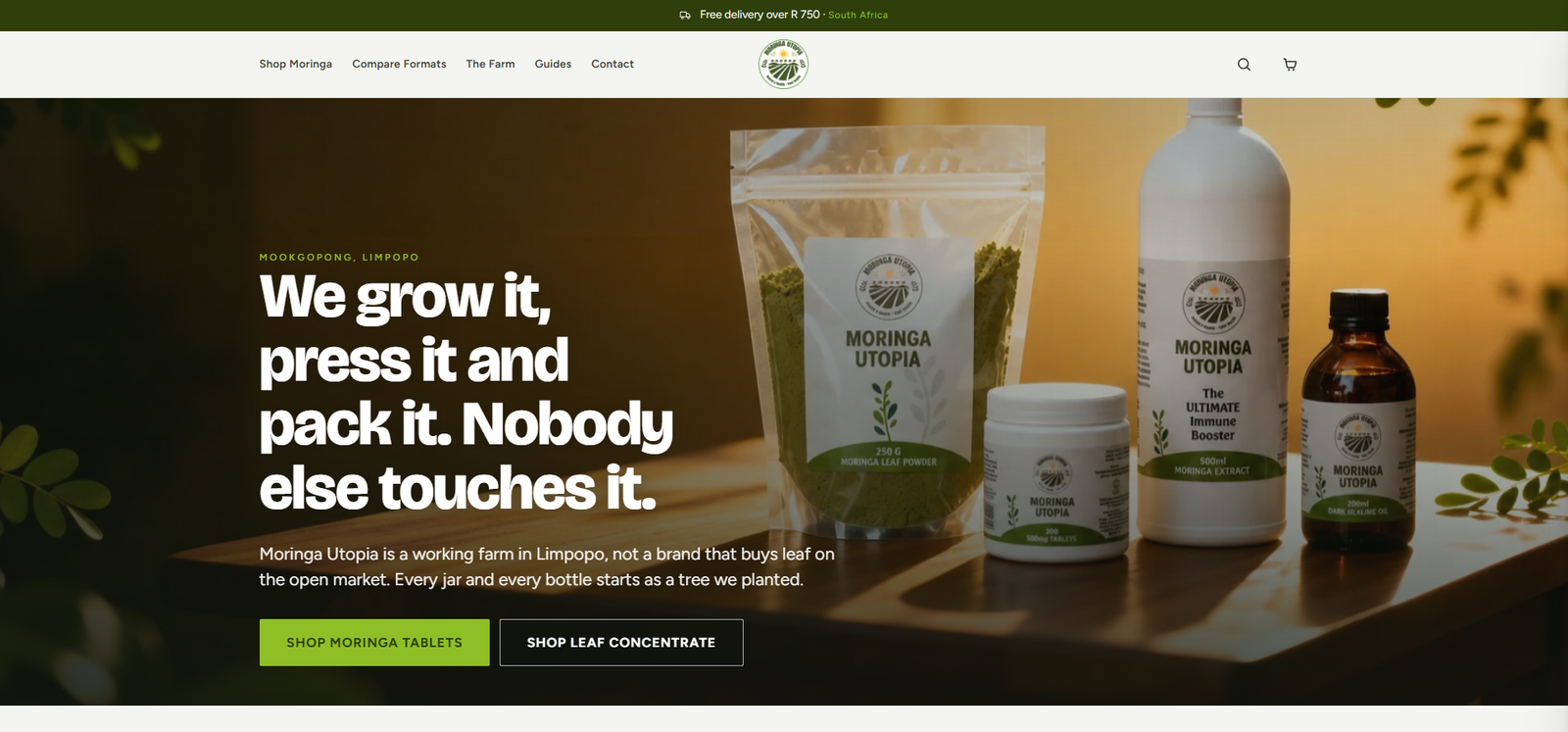
Farm to checkout
A full store build covering the product range, the story behind the farm, and a guides section that brings in search traffic the product pages could never rank for on their own.
- Full store build on WooCommerce
- Product range across powders, extracts and oils
- Blog and guides architecture
- Farm story and provenance pages
Ecommerce pricing
Ecommerce website development is more work than a brochure site, so it has its own numbers. Published, because you should not have to book a call to find out what a store costs.
Enough to start selling properly, without paying for scale you do not have yet.
- ●Up to 30 products loaded
- ●One payment gateway configured and tested
- ●Courier rates by weight and region
- ●Five supporting pages — about, contact, policies
- ●On-page SEO and product schema
- ●A walkthrough of adding products and handling orders
For a bigger catalogue, or a store that has to do something particular.
- ●Unlimited products and variations
- ●Multiple gateways and delivery options
- ●Subscriptions, bundles or wholesale pricing
- ●Accounting, CRM or inventory integrations
- ●Full content and SEO architecture
- ●Timeline agreed before anything starts
Ecommerce questions, answered.
Most quotes in South Africa land somewhere between R15,000 and R60,000, depending on catalogue size and how much of it is custom. Ours sit below it — R10,000 for a Starter store, from R25,000 for custom work. On top of the build you should budget roughly R1,200 a year for hosting and a domain, and the gateway's transaction fee — usually somewhere around 2 to 4 percent per order, charged by them, not by us.
For most new stores, PayFast or Yoco. Both are widely recognised here, both handle cards and instant EFT, and both are straightforward to get approved for. Ozow is worth adding if a lot of your customers prefer paying straight from their bank. We will talk through the fee structures with you before you sign up for anything, because the cheapest headline rate is not always the cheapest once you look at how your orders actually come in.
Yes, and you should — it is the part of the site you will touch most. We load the first batch, set up the structure for variations, stock and images, then walk you through adding the rest. If you have hundreds of lines in a spreadsheet we import them in bulk rather than making you type them in.
Three to four weeks for a Starter store, six to ten for custom work. Stores take longer than brochure sites mainly because of product data — photographs, descriptions, weights and stock numbers. Having that ready in a spreadsheet before we start is the single biggest thing you can do to shorten it.
On properly specified hosting, yes. The usual failure is not traffic volume but an under-resourced shared host struggling with checkout requests while caching is switched off for the cart. We size the hosting to your expected peak rather than your average, and test it before the day rather than during it.
We set up the parts that live on the site: cookie consent that genuinely holds tracking until it is accepted, a privacy policy matching what the store actually collects, and order data stored where you can export or delete a customer's records on request. The commercial side — registering an information officer, your internal processes — is yours, and we will point you at what is required.
Usually. Products, variations, customers and order history all migrate. The design is rebuilt rather than transferred, and we map redirects from old product URLs so the rankings you have already earned follow you across. Before we quote it we will check whether moving is actually worth it for you — sometimes it is not.
Then say so and we will tell you honestly whether you need a full store at all. For three or four products, a normal site with a payment link often does the job for a fraction of the cost. We would rather build you the right thing than the bigger thing.
People usually mean two halves of one job. Ecommerce website design is what the customer sees — the product pages, the navigation, how the cart and checkout behave. Development is everything behind it: the gateway, the courier rates, the stock, the speed. Split those between two suppliers and the seams show up in the checkout, which is exactly where you cannot afford them. We do both, so there is nobody to hand the problem to.
Tell us what you sell.
How many products, where they ship, and how people pay for them. We will tell you honestly which tier fits and what it would cost. A reply inside two working days.
No newsletter, no follow-up sequence. One reply from a person, inside two working days.